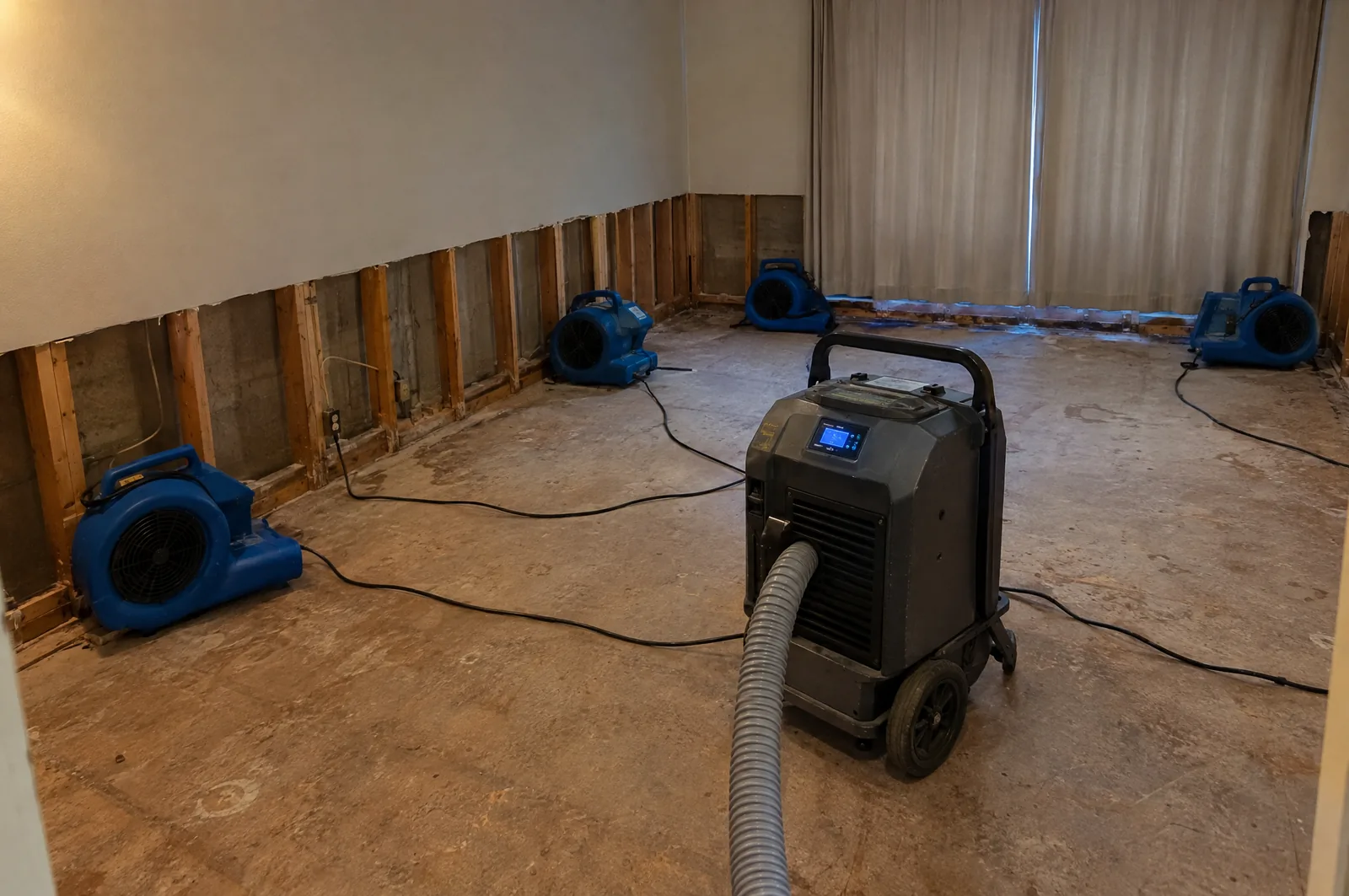
Four air movers and a low-grain refrigerant dehumidifier drying a room after a flood cut exposed the wall studs and bottom plate in a Tumwater, WA home
Dry To A Number, Not A Feeling

Structural Drying In Tumwater, WA

"It looks dry" is not a measurement. We dry to a documented number, on every affected material, and you get the log.

TRUSTED BY HOMES & BUSINESSES ACROSS THURSTON COUNTY

Overview

Structural Drying & Drywall Water Damage Repair

Drying is where a water loss is either finished or quietly turned into a mold job twelve months from now. It is also the easiest part to fake, because a wall can feel perfectly dry to the hand while the framing behind it is still wet enough to grow mold all winter.

Why Drying Is Harder In Western Washington

Drying works by creating a gradient: you make the air drier than the material, and the material gives up its water to the air. In most of the country you can do a lot of that for free by opening the windows.

Here you cannot. From roughly October through May, outdoor air in Thurston County sits near saturation. Bring it inside and it is not thirsty, so there is nothing to pull water out of your framing. Worse, when that wet air meets cool surfaces inside the structure, it deposits moisture rather than removing it.

So drying in this climate means a closed envelope and mechanical dehumidification doing all the work. It takes more equipment and more days than the same loss in a dry climate, and the most common mistake homeowners make is opening the house up because it feels intuitively right.

Dry Standard, Not “Looks Dry”

Before equipment goes down we take readings from an unaffected area of your house, with the same materials, in the same conditions. That is the dry standard. It is the number the affected materials have to reach.

This matters because there is no universal target. The moisture content that counts as dry for framing in a Tumwater home in February is not the number from a textbook or from a house in Phoenix. Taking the baseline from your own structure is the only way the readings mean anything.

Then every affected material gets metered daily until it reaches that number on consecutive days. Equipment comes out on the readings, not the calendar.

You Get The File

At closeout you receive the daily moisture logs, the psychrometric readings, the equipment records, and the photos. Most restoration customers never see this, and most never think to ask for it.

Ask for it. It is the only evidence that your house was actually dried, and it is what answers the question if mold turns up in a year, or a home inspector finds a past water stain when you sell.

Get Help Now

Call us. 24/7 dispatch across Tumwater and Thurston County, IICRC-certified technicians, documented drying, and we handle the insurance.

Scope of Work

What Our Structural Drying Service Includes

Closed-Envelope Drying, Because Open Windows Do Not Work Here

From October through May, outdoor air in Thurston County typically carries more moisture than the air you are trying to dry. Opening the house up adds water to the problem. We dry closed with mechanical dehumidification, which is the only approach that works in this climate.

LGR Dehumidification Sized To The Loss

Low-grain refrigerant dehumidifiers pull moisture down to levels conventional units cannot reach, which is what actually dries framing rather than just the air. Unit count comes from the cubic footage, class of loss, and materials involved, calculated rather than estimated.

A Real Dry Standard, Taken From Your Own House

Dry standard is established from an unaffected area of the same structure with the same materials, so the target reflects your building rather than a textbook number. Without that baseline, moisture readings are data with nothing to compare against.

Daily Readings On Every Affected Material

Drywall, framing, subfloor, insulation, and flooring get metered every single day. Equipment gets repositioned as the readings move. This is what separates drying from leaving fans in a room for a few days and hoping.

You Receive The Complete Psychrometric Log

Daily moisture readings, temperature and humidity data, equipment placement records, and photos, handed over at closeout. Most homeowners never see this file. It is what proves the structure was actually dried if mold appears a year from now and someone asks who dried it.

How It Works

Our Structural Drying Process, Step By Step

  1. Step 1

    Moisture Mapping And Dry Standard

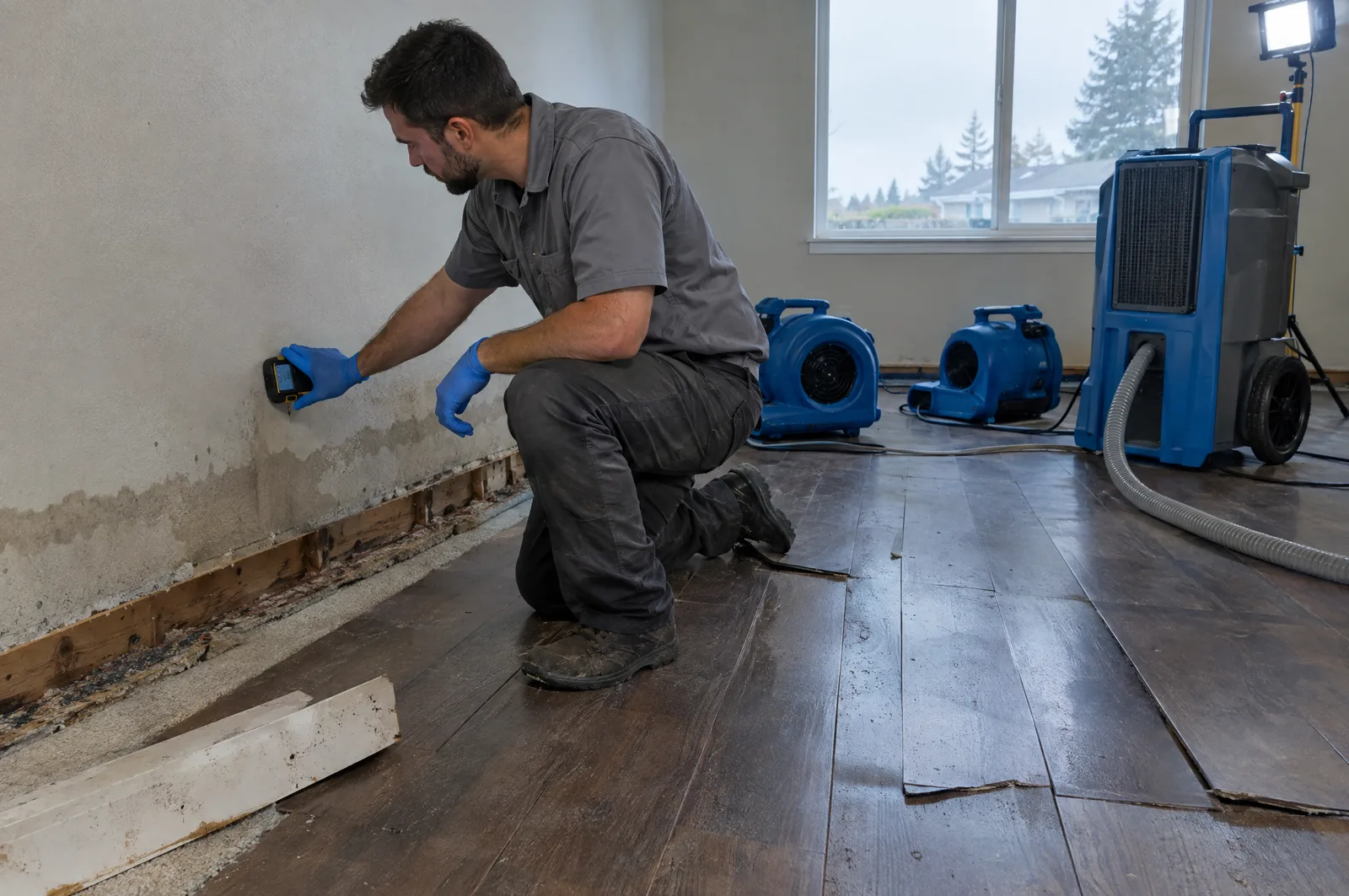
    Before a single piece of equipment goes down, we map every affected material with a moisture meter and thermal camera and establish a dry standard from an unaffected area of the same structure. Those two things together define the job: what is wet, how wet, and what number we are driving it to. Skipping this is why so many drying jobs end on a guess.

  2. Step 2

    Equipment Calculation And Placement

    Air mover count comes from the affected wall and floor area. Dehumidifier capacity comes from the cubic footage and the class of loss. We place to move air across wet surfaces and pull the moisture out of the space, not to fill the room with fans. Where water is inside a wall cavity or under hardwood, we use injection drying or controlled access rather than removing finishes that could be saved.

  3. Step 3

    Closing The Envelope

    Windows and exterior doors stay shut and the HVAC gets set appropriately. This is the step people most want to argue with, and it is the one that matters most in this climate. Outdoor air here is usually wetter than the air inside the structure you are drying, so every hour the house is open is an hour of progress given back.

  4. Step 4

    Daily Monitoring And Adjustment

    A technician returns every day, takes readings on every affected material, records temperature and relative humidity, and logs it. Equipment moves as the readings tell us to move it, because the wet areas at day four are not the same as the wet areas at day one. If something is not drying on the expected curve we find out why on day two rather than at the end of the week, and it is usually water trapped in an assembly nobody has opened yet.

  5. Step 5

    Verification And Closeout

    Equipment comes out when every affected material reads at or below dry standard on consecutive days. We do a final walkthrough with you and hand over the complete file: daily moisture logs, psychrometric readings, equipment records, before and after photos, and a written statement of what was removed and why. Your repair contractor builds from that file, and nobody is guessing about what is behind the wall they close up.

24/7 Emergency Response

Ready For Structural Drying?

Call now for 24/7 emergency response across Thurston County. IICRC-certified technicians, insurance handled.

FAQs

Structural Drying Questions From Tumwater Homeowners

  • Because of where you live. For most of the year the outdoor air in Thurston County is near saturation, so opening the house brings in air that is already carrying about as much moisture as it can hold. There is nowhere for the water in your framing to go. Household fans make matters worse in a subtler way: they move water out of the carpet and into the air, and with no dehumidification it lands on the next cool surface, which is often the inside of a wall cavity. You end up having moved the problem somewhere you cannot see.

  • Three to five days for most residential losses, and longer in midwinter when ambient conditions work against the equipment continuously. Hardwood, plaster, multi-layer flooring assemblies, and crawlspaces all take longer. We do not commit to a number up front because the honest answer is that the readings decide, and we would rather show you the numbers each day than promise a Friday finish and then either miss it or pull equipment early.

  • Yes. Drying is continuous, and the equipment is doing its most useful work in the hours nobody is opening doors. Turning it off overnight can add a full day. It is loud and it uses electricity, and both of those are worth it. On insured losses the power consumption is a recognized line item on the claim.

  • Every affected material reads at or below the dry standard we took from an unaffected part of your own house, on consecutive days rather than one good reading. A single reading can be misleading if a surface has dried faster than the material behind it, which is why it is consecutive days on every material rather than a spot check before loading the truck.

  • Often they can be dried, and it is worth trying. Specialty hardwood drying systems pull moisture up through the boards rather than only off the surface, which can save a floor that would otherwise be a full replacement. It takes longer than drying carpet and it does not always work, particularly if the floor has been wet for a long time or has already cupped severely. We will tell you honestly at the assessment whether we think it is savable.

  • Mold, typically showing up weeks to months later, along with odor, and in longer-running cases rot in the framing. The difficult part is that it is invisible at the time: a wall that was closed up wet looks exactly like a wall that was closed up dry. That is the entire reason for the documentation. The moisture log is the proof that the structure actually reached dry standard, and it is what you want in hand if a buyer, an inspector, or an insurer asks a year from now.

24/7 Emergency Restoration

Don't Wait. Call Now.

Open 24/7 - Emergency Dispatch

Tap To Call (877) 524-6411